
Trailer Connector
 Trailer connector
Trailer connector

Trailer connector

Trailer connector

Trailer connector

Trailer connector

Trailer Connector & Cable
 Trailer connector
Trailer Adapter

Trailer Connector
Model/Item No.:SY-750P
7-pole heavy duty . Trailer connector . Trailer end

Trailer Connector

Trailer Connector

Trailer Connector

Trailer Connector

Trailer Connector
SY-602S
SY-710S
SY-770S: Nylon Plastic, 7-pole heavy duty trailer connector . car end

Trailer Connector

Trailer Connector

Trailer Connector

Trailer Connector

Trailer Connector
SY-400: 4-way Tester
SY-700: 7-way Tester


Trailer Connector

7-Way Tester

Trailer Connector
SY-251P 2 -WAY PLUG VERTICAL PIN WITH SPRING
SY-150P 1- WAY PLUG WITH SPRING

Trailer Connector
SY-712S 7-WAY SOCKET LI D WITH SEAL.
SY-150S 1- WAY SOCKET
SY-251S 2-WAY SOCKET VERTICAL PIN
Trailer Connector | 2-Pole, 4-Way, 6-Pole & 7-Way Trailer Connectors
A trailer connector is an essential electrical component used to establish a connection between a towing vehicle and a trailer. Through the connector, electrical signals and power can be transferred from the vehicle to the trailer for lighting, turn signals, brake lights and other electrical functions, depending on the wiring configuration and trailer application.
Different trailers require different numbers of electrical circuits. For this reason, trailer connectors are available in a variety of configurations, including 1-way, 2-pole, 4-way, 6-pole and 7-way designs. They can also be manufactured as trailer plugs, vehicle-side sockets, connector sets, cable assemblies and other configurations.
Song Yers Industrial Co., Ltd. provides a broad selection of trailer connectors for towing, trailer and vehicle electrical applications. Available products include plastic and zinc die-cast designs, as well as heavy-duty trailer connectors for applications requiring a durable connection.
What Is a Trailer Connector?
A trailer connector is an electrical interface that connects the wiring of a towing vehicle to the electrical system of a trailer.
A typical connection consists of a plug and a corresponding socket. The plug is commonly connected to the trailer wiring, while the socket is generally mounted on the towing vehicle.
Once connected, electrical circuits can transmit the signals required by the trailer.
Depending on the connector configuration, these functions may include running lights, brake lights, left and right turn signals and other electrical circuits.
Because different trailers and towing vehicles can use different wiring systems, the connector should always be selected according to the actual electrical and installation requirements.
What Types of Trailer Connectors Are Available?
Trailer connectors can be classified according to the number of poles or electrical contacts.
Song Yers offers different configurations, including 1-way, 2-pole, 4-way, 6-pole and 7-way trailer connector products.
The correct configuration depends on how many electrical circuits are required between the towing vehicle and trailer.
A simple application may need only a small number of electrical connections, while larger trailers and RV applications can require additional circuits.
For this reason, buyers should not choose a trailer connector based only on appearance. Connector configuration, plug and socket compatibility, wiring arrangement and electrical requirements should all be confirmed before ordering.
2-Pole Heavy Duty Trailer Connector
A 2-pole trailer connector is suitable for applications that require two electrical connections.
Song Yers offers zinc die-cast 2-pole heavy-duty trailer connectors, including vehicle-side and trailer-side configurations.
For example, the SY-250S is a zinc die-cast 2-pole heavy-duty connector for the car end, while the SY-250P is a zinc die-cast 2-pole heavy-duty trailer connector with spring for the trailer end.
Matching the correct plug and socket is important for creating a suitable connection between the towing vehicle and trailer.
4-Way Trailer Connector
A 4-way trailer connector is commonly associated with trailer applications that require basic lighting-related electrical circuits.
Depending on the wiring configuration, these circuits can be used for functions such as tail or running lights, left and right turn/brake signals and ground.
Four-way connections are often used where additional circuits for more complex trailer equipment are not required.
Song Yers also provides products related to 4-way trailer electrical systems, including trailer connector testers and adapters for selected connector configurations.
Before installation, users should verify the actual wiring arrangement rather than assuming that every 4-way connector follows the same installation requirements.
6-Pole Trailer Connector
A 6-pole trailer connector provides additional electrical contacts compared with a basic 4-way connection.
This makes it suitable for trailer applications requiring more electrical circuits.
Song Yers offers 6-pole trailer connector products such as the SY-612S, a zinc die-cast 6-pole socket with exposed terminals for the car end.
When selecting a 6-pole connector, buyers should determine whether they require the towing vehicle side, trailer side or a complete matching connection.
The electrical function assigned to each terminal should also be verified before installation.
7-Way Trailer Connector
The 7-way trailer connector is an important product category for trailers, RVs and towing applications requiring multiple electrical circuits.
Compared with simpler connector configurations, a 7-way connector provides additional contacts that can accommodate more electrical functions.
Depending on the vehicle and trailer wiring system, these circuits may be used for lighting, brake and turn signals, electric brake-related connections, auxiliary power, reverse functions or other requirements.
Song Yers provides multiple 7-way trailer connector designs, including plugs, sockets, complete connector sets, plastic models and zinc die-cast heavy-duty products.
7-Pole Heavy Duty Trailer Connectors
For applications where a strong connector housing is required, Song Yers offers zinc die-cast heavy-duty trailer connectors.
The SY-750PN, for example, is a zinc die-cast 7-pole plug for the trailer end. The SY-750P is another 7-pole heavy-duty trailer connector designed for the trailer end.
For the vehicle side, the SY-750S is a zinc die-cast 7-pole heavy-duty trailer connector.
A complete plug-and-socket combination can provide a practical connection between the towing vehicle and trailer while offering the additional circuits associated with a 7-pole configuration.
Plastic Trailer Connectors
Not every trailer application requires a metal housing.
Plastic trailer connectors are also available for different towing applications. For example, Song Yers offers the SY-710S 7-way plastic connector for the car end and the SY-770S nylon plastic 7-pole heavy-duty trailer connector.
Plastic and nylon connector designs can provide a practical option where weight, electrical insulation, product construction and application requirements make plastic housing appropriate.
Buyers should compare the complete connector specification rather than selecting a product based only on housing material.
Trailer Plug vs. Trailer Socket
Trailer plugs and trailer sockets form the two sides of an electrical connection.
The trailer plug is typically installed on the trailer side, while the trailer socket is generally installed on the towing vehicle.
When the plug is inserted into the corresponding socket, the terminals establish the electrical connection between the vehicle and trailer.
When purchasing replacement connectors, it is important to identify whether you require a car-end socket, trailer-end plug or complete connector set.
The number of poles and connector configuration must also be compatible.
Trailer Connector and Cable Assemblies
Some applications require more than an individual plug or socket.
A trailer connector and cable assembly combines the connector with a length of wiring cable, providing a more integrated product for selected installation requirements.
Song Yers offers the SY-750W trailer connector and cable, featuring a 7-pole trailer cable.
For manufacturers, distributors and replacement-part suppliers, connector-and-cable products can provide another option when sourcing trailer electrical components.
The appropriate cable specification should always be selected according to the intended electrical application.
Zinc Die-Cast Trailer Connectors
Housing construction is an important consideration when selecting a trailer connector.
Song Yers offers multiple zinc die-cast models, including 2-pole, 6-pole and 7-pole connector configurations.
Die-cast housings provide a robust structure that can be suitable for selected heavy-duty towing applications.
However, housing material is only one selection factor. Buyers should also consider the number of electrical contacts, terminal design, plug/socket compatibility, mounting method, wiring requirements and operating environment.
Trailer Connector Testers
Electrical connection problems can result from wiring errors, poor connections or problems elsewhere in the trailer electrical system.
A trailer connector tester can help users check selected electrical circuits and identify potential connection issues.
Song Yers' product range includes the SY-400 4-way tester and SY-700 7-way tester.
Using an appropriate tester can make it easier to check trailer electrical connections before troubleshooting other components.
How to Choose the Right Trailer Connector
The first step in selecting a trailer connector is identifying the electrical requirements of the towing vehicle and trailer.
Buyers should determine the required number of circuits, connector configuration and whether the product is intended for the vehicle end or trailer end.
Important factors include the number of poles, plug or socket design, housing material, terminal arrangement, wiring system, trailer type and installation environment.
For replacement applications, comparing the existing connector model, physical configuration and wiring can help avoid compatibility problems.
For B2B purchasing, providing product specifications, photos, drawings or existing part information can also help the supplier identify an appropriate trailer connector.
Trailer Connector Manufacturer in Taiwan
Song Yers Industrial Co., Ltd. provides trailer connectors for a wide range of towing and trailer electrical applications.
The product line includes 1-way, 2-pole, 4-way, 6-pole and 7-way products, as well as plugs, sockets, heavy-duty zinc die-cast connectors, plastic connectors, cable assemblies and trailer connector testers.
For importers, distributors, trailer parts suppliers and automotive aftermarket buyers, the broad selection makes it possible to source multiple trailer connector configurations according to different vehicle, trailer and market requirements.
Trailer Connector FAQ
1. What is a trailer connector?
A trailer connector is an electrical component used to connect a towing vehicle to a trailer.
It provides electrical paths between the vehicle and trailer so that required signals and power can be transferred.
Depending on the connector and wiring configuration, these circuits can support trailer lights, brake lights, turn signals and additional electrical functions.
Trailer connectors are available with different numbers of contacts because different trailers have different electrical requirements.
2. What is the purpose of a trailer connector?
The main purpose of a trailer connector is to allow the trailer electrical system to communicate with the towing vehicle.
For example, when a driver activates the vehicle's turn signal, the corresponding trailer signal should operate.
Similarly, when the vehicle brakes, the trailer brake lights need the appropriate electrical signal.
More complex towing systems may require additional circuits, which is why connectors with different numbers of poles are available.
3. What are the common trailer connector types?
Trailer connectors are available in many configurations, including 1-way, 2-pole, 4-way, 6-pole and 7-way products.
Four-way connectors are commonly associated with basic trailer lighting connections, while 6-pole and 7-way connectors provide additional contacts for applications requiring more electrical circuits.
Song Yers offers multiple connector configurations, including plugs, sockets, connector sets, plastic connectors and zinc die-cast models.
4. What is a 2-pole trailer connector?
A 2-pole trailer connector provides two electrical contact points.
It can be used in applications that require a relatively simple electrical connection.
Song Yers offers zinc die-cast heavy-duty 2-pole products for both vehicle-end and trailer-end applications, including the SY-250S and SY-250P.
Before purchasing, buyers should verify that the connector configuration and electrical requirements match their intended application.
5. What is a 4-way trailer connector?
A 4-way trailer connector provides four electrical connections.
It is commonly used for trailers with relatively basic lighting requirements.
Depending on the wiring system, the circuits can be associated with running lights, turn/brake signals and ground.
Because actual wiring configurations may differ, installation should always follow the appropriate wiring information for the vehicle, trailer and connector.
6. What is a 6-pole trailer connector?
A 6-pole trailer connector provides six electrical contacts between the towing vehicle and trailer.
The additional contacts allow it to support more circuits than simpler connector configurations.
Song Yers offers products such as the SY-612S zinc die-cast 6-pole socket for vehicle-end applications.
When selecting a 6-pole product, verify the connector style, wiring arrangement and required electrical functions.
7. What is a 7-way trailer connector?
A 7-way trailer connector provides seven electrical contacts and is commonly used for towing applications that require several electrical circuits.
Depending on the vehicle and trailer configuration, these can include lighting, turn and brake signals, auxiliary electrical connections and other functions.
Song Yers offers multiple 7-way products in plastic and zinc die-cast configurations.
8. Is a 7-way connector the same as a 7-pole trailer connector?
The terms are often used to describe trailer connectors with seven electrical connection points, although terminology can vary by market and connector design.
For B2B purchasing, it is better not to rely only on the terms “7-way” or “7-pole.”
Buyers should compare the physical connector, terminal arrangement, wiring specification and vehicle/trailer application to ensure compatibility.
9. What is a heavy-duty trailer connector?
A heavy-duty trailer connector is generally designed with a robust construction for demanding towing applications.
Song Yers offers several heavy-duty models with zinc die-cast housings, as well as selected nylon plastic designs.
When choosing a heavy-duty connector, buyers should consider not only the housing but also terminal configuration, mounting, wiring, frequency of use and operating environment.
10. What is the difference between a trailer plug and a trailer socket?
A trailer plug is generally located on the trailer wiring side, while a corresponding socket is commonly installed on the towing vehicle.
The plug fits into the socket to create the electrical connection.
Some products are sold separately, while others are available as connector sets.
Before ordering, identify whether you need a trailer-end plug, car-end socket or both components.
11. Are metal trailer connectors better than plastic connectors?
Neither material is automatically better for every application.
Zinc die-cast housings provide a strong structural design and are available for various heavy-duty connector models.
Plastic and nylon products can provide different benefits related to weight, insulation and product construction.
The correct choice depends on the installation environment, connector design, required number of poles and actual towing application.
12. What is a zinc die-cast trailer connector?
A zinc die-cast trailer connector uses a die-cast zinc housing around the connector assembly.
Song Yers uses zinc die-cast construction on selected 2-pole, 6-pole and 7-pole products.
This construction can provide a robust housing for selected towing applications.
However, the buyer should still evaluate electrical configuration, terminal design, compatibility and installation requirements before selecting a connector.
13. How do I choose between a 4-way, 6-pole and 7-way connector?
Start by determining how many electrical circuits the trailer requires.
A trailer with basic lighting requirements may use a simpler connector, while a trailer with additional electrical equipment may need a connector with more contacts.
Do not select the connector only according to trailer size.
The towing vehicle wiring, trailer wiring and electrical functions should be checked first.
14. Are all 7-way trailer connectors compatible?
No.
Two connectors may both be described as 7-way or 7-pole but still have different physical designs, terminal arrangements or wiring requirements.
Different markets and applications may also use different configurations.
For replacement applications, compare the existing connector carefully.
For new installations, use the wiring information and connector specifications applicable to the towing vehicle and trailer.
15. Can I convert a 7-way trailer connector to a 4-way connection?
For selected applications, a trailer adapter can be used to connect different connector configurations.
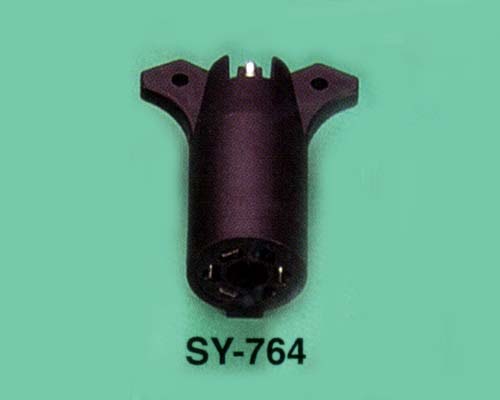
Song Yers, for example, offers the SY-764 7-way to 4-way flat adapter.
However, an adapter does not create electrical functions that are not available in the original wiring system.
Always verify the vehicle and trailer circuits before using an adapter.
16. What is a trailer connector tester?
A trailer connector tester is a diagnostic accessory used to help check trailer electrical connections.
Depending on the tester design, it can assist in identifying whether selected circuits are receiving the expected signals.
Song Yers offers the SY-400 4-way tester and SY-700 7-way tester.
A tester can be useful when troubleshooting trailer lighting or connection problems.
17. Why is my trailer connector not working?
Possible causes include a loose plug/socket connection, damaged wiring, poor grounding, contaminated or corroded terminals, incorrect wiring or incompatible connector configurations.
Start by inspecting the connector and wiring for visible damage.
Then verify that the plug is correctly seated and that the wiring matches the required configuration.
An appropriate tester may also help identify electrical connection problems.
18. How should I maintain a trailer connector?
Trailer connectors should be inspected periodically, particularly when they are frequently exposed to road conditions or repeated connection and disconnection.
Check the housing, terminals, wiring and mounting area for physical damage, contamination or corrosion.
Make sure the connector remains properly secured and that wiring is not being stretched or pinched.
Follow the appropriate product and vehicle maintenance recommendations.
19. What should B2B buyers provide when requesting a quotation?
Providing detailed information can make product selection more efficient.
Useful information includes the required number of poles, plug or socket type, car-end or trailer-end application, housing material, existing model or reference product, required quantity and destination market.
Photos, drawings and wiring information can also be helpful when sourcing a replacement or equivalent connector.
20. Where can I find a trailer connector manufacturer?
Song Yers Industrial Co., Ltd. is a Taiwan manufacturer supplying a range of trailer connectors and related towing electrical products.
The current product range includes 1-way, 2-pole, 4-way, 6-pole and 7-way configurations, zinc die-cast heavy-duty connectors, plastic connectors, trailer plugs, sockets, cable assemblies and connector testers.
For importers, distributors and trailer parts buyers, selecting the correct product begins with identifying the required connector configuration, electrical functions and installation requirements.